6.14.15 Flag Day 25 Scaled Aspect Ratio 3 1

Naturalization Process & Requirements

Learn the Process to Apply & Eligibility Requirements

The application to become a U.S. citizen (also called naturalization) is a multi-step process. There are five (5) basic requirements you will need to meet. The specific steps required to fulfill each requirement may vary from person to person. You should seek advice from an immigration attorney or U.S. Department of Justice (DOJ)-accredited nonprofit legal services provider before applying for citizenship.

Eligibility Requirements

There are basic requirements you must meet before applying for naturalization. Additional requirements may apply depending on your specific situation, as each person’s immigration journey varies. Ensuring that the specifics of your case are fully accounted for before completing your forms—and that the proper documentation is submitted with your application—is essential. Before applying, meet with an immigration attorney or DOJ Representative to confirm that you are eligible and that it is safe for you to file.

See below for the basic requirements everyone must meet before exploring whether they should apply. Additionally, USCIS, the agency that oversees immigration and naturalization applications, provides an online tool to help you check your basic eligibility for naturalization.

You must be 18 years of age or older.

To satisfy this requirement, you must have been a resident of the state or USCIS district where you plan to apply for citizenship for at least three months immediately prior to applying for naturalization.

To apply for citizenship, you must be a Lawful Permanent Resident (Green Card holder) and meet all the time rules under one of the tracks below:

Track 1: The General Rule

  • Time as a Lawful Permanent Resident: At least 5 years.
  • When you can apply: Up to 90 days before your 5-year anniversary.

Track 2: The Marriage Rule

  • Time as a Lawful Permanent Resident: At least 3 years.
  • When you can apply: Up to 90 days before your 3-year anniversary.
  • Marriage requirement: You must be married to, and living with, a U.S. citizen. Your spouse must have been a U.S. citizen for the entire 3 years.

________________________________________________________________

Special Rule for Refugees and Asylees

  • If you received your Green Card after being granted asylum or refugee status, the date that matters is the “Resident Since” date printed on your Green Card.
  • How it works: USCIS rules backdate your permanent residency automatically when your Green Card is approved. It might feel like you have only had your card for 4 years, but your card will show a retroactive start date.
  • Simply look at the “Resident Since” date on your card. Once 5 years have passed from that specific date, you meet the time requirement to apply for citizenship.

________________________________________________________________

Continuous and Physical Residence

Additionally, to qualify for U.S. citizenship, you must meet distinct time-based rules regarding where you maintain your home (Continuous Residence) and how many actual days you spend inside the country (Physical Presence):

5-Year General Rule: You are applying based on holding a Green Card for at least 5 years.

  • You must show 5 years of Continuous Residence, meaning you maintained your primary home in the U.S. and did not abandon it.
  • You must meet the Physical Presence requirement by spending a total of at least 30 months (913 days) physically on U.S. soil out of those 5 years.

3-Year Spousal Rule: You are applying based on being married to a U.S. citizen for at least 3 years.

  • You must show 3 years of Continuous Residence while living in marital union with your U.S. citizen spouse.
  • You must meet the Physical Presence requirement by spending a total of at least 18 months (548 days) physically on U.S. soil out of those 3 years.

_______________________________________________________________________

Critical Travel Rules

Leaving the United States while holding a Green Card can affect your eligibility during your 3-year or 5-year calculation period:

  • Trips of 6 to 12 months: These trips trigger heavy scrutiny. USCIS may assume you broke your “continuous residence.”
  • Trips of 1 year or more: These trips are generally considered an automatic break in your continuous residence.

Note: be aware that these are general guidelines. As mentioned before, your specific case—including the length and number of trips you took during the 5‑ or 3‑year period—should be evaluated individually with the support of an attorney or DOJ accredited representative with experience handling naturalization cases to assess any available relief and determine the best course of action for you.

You must be a person of good moral character; this primarily involves meeting the criteria defined by U.S. Citizenship and Immigration Services (USCIS). Whether you satisfy this definition depends on your past behavior related to taxes, financial obligations to children, employment, community ties, and any criminal record. Particular attention must be paid to your criminal record.

Being unable to satisfy the Good Moral Character requirements—such as having conditional bars—may delay the date you can apply for naturalization. In more serious cases, if you are found to have permanent bars, you may never be able to become a U.S. citizen.

In general, you should always seek advice from an immigration attorney or a DOJ-Recognized legal services provider before applying for citizenship, especially if you have ever been arrested.

In general, you must report any criminal history on your application. Even if something was removed from your criminal record or it happened many years ago.

If any of the following is true for you, you will need legal advice and possibly representation before applying for citizenship:

(Note: These things don’t necessarily mean that you cannot apply for naturalization, but you should consult with an immigration attorney or DOJ Accredited representative with experience handling naturalization cases to evaluate if it is safe to apply. This may also mean that you will need that person to attend the interview with you.)

  • Since getting your green card, you have been out of the U.S. for more than six months at a time.
  • You have moved to another country since getting your green card.
  • You have been arrested for, charged with, convicted of, or have admitted to committing a crime.
  • You have been arrested for any drug-related offense.
  • You have worked in the marijuana industry.
  • You have been involved in prostitution or commercialized vice.
  • You have engaged in or are engaging in activity USCIS calls “terrorist activity.”
  • You have been involved with illegal gambling.
  • You are on probation or parole related to a criminal conviction.
  • A court has determined that you violated a protection order.
  • You are in deportation or removal proceedings or have a removal order – past or present.
  • You have helped someone come to the U.S. illegally, even if the person is your child or spouse.
  • You were a male who lived in the U.S. between the ages of 18 and 26 and did not register for the Selective Service.
  • You did not pay your taxes, currently owe overdue taxes, or filed your taxes as a nonresident alien (Form 1040-NR).
  • You did not pay child support.
  • You are what USCIS calls a habitual drunkard.
  • You came to the U.S. to practice polygamy and/or have practiced polygamy since moving to the U.S.
  • You have voted or registered to vote in any election in the U.S.
  • You claimed to be a U.S. citizen verbally or on a written form.
  • The information on your citizenship application differs from or contradicts the information you gave to get your green card or another immigration status.
  • You have lied or given false information to retain or obtain an immigration benefit, including your green card.
  • USCIS approved your Green Card by mistake, even if the error was entirely made by the agency.

There are three major components of the interview that can be considered a “test.”

The first one is the reading and writing tests, which are usually conducted using a tablet provided by the USCIS officer conducting the interview. Review here the possible vocabulary used in these tests.

  • During the reading test, you must read 1 out of 3 sentences aloud correctly.
  • During the writing test, you must write 1 out of 3 sentences in English correctly.

The second component is the speaking test, although it is not directly part of the reading and writing tests, those who do not qualify for a language exemption will have their interview conducted in English. Therefore, the USCIS officer will also assess your ability to speak and understand English throughout the interview process.

We recommend that you:

  • Review your application so that you understand it and are prepared to answer questions about it.
  • Review this document to practice the words used in the citizenship application form and make sure you understand them, as the USCIS officer may ask you about them to make sure you understand the questions and can answer them truthfully.

The third one is the U.S. history and civics test. For the civics test, you must study a pool of 128 questions. You will be asked up to 20 questions, and you must answer at least 12 correctly to pass. However, you may qualify for an exception based on your age and time as a lawful permanent resident, or due to a medical condition:

  • 50/20 Rule: You are at least 50 years old AND a Permanent Resident for at least 20 years.
    • You do not need to take the reading and writing English tests.
      • Note: This exempts you from reading up to 3 sentences and writing up to 3 sentences in English.
    • You must take the civics test. Find the 128 questions in other languages here.
      • This civics test covers the history and government of the United States.
      • The pool consists of 128 questions, you will be asked up to 20, and you need to get 12 correct to pass.
      • You take the civic test in your native language but you must bring an in-person interpreter to your interview.
  • 55/15 Rule: You are at least 55 years old AND a Permanent Resident for at least 15 years.
    • You do not need to take the reading and writing English tests.
      • Note: This exempts you from reading up to 3 sentences and writing up to 3 sentences in English.
    • You must take the civics test. Find the 128 questions in other languages here.
      • This civics test covers the history and government of the United States.
      • The pool consists of 128 questions, you will be asked up to 20, and you need to get 12 correct to pass.
      • You take the civic test in your native language but you must bring an in-person interpreter to your interview.
  • 65/20 Rule: You are at least 65 years old AND a Permanent Resident for at least 20 years.
    • You do not need to take the reading and writing English tests.
      • Note: This exempts you from reading up to 3 sentences and writing up to 3 sentences in English.
    • You take a simplified, shorter civics test in your native language using the special 65/20 study guide. Which set of 20 questions you study will depend on when you submitted your application:
      • BEFORE October 20, 2025: set of 20 questions. You can also find these same 20 questions on the 100-question list; they are marked with an asterisk (*).
      • ON or AFTER October 20, 2025: set of 20 questions. You can also find these same 20 questions on the 128-question list; they are marked with an asterisk (*).
        • 20 Civics Questions in Spanish (20 questions from the 128-question list)
        • Find the 20-question list in other languages here.
          • You only study 20 specific questions and must answer 6 out of 10 correctly to pass.
          • You must bring an in-person interpreter to your interview if you intend to take the civics test in a language other than English.
  • Medical Exception (Form N-648): You have a physical or developmental disability or mental impairment.
    • You may qualify for a full waiver of both the English and civics tests.
    • Your medical doctor must complete Form N-648 to certify your condition.

Naturalization Application Process

There are multiple steps involved in applying for naturalization. Read through each step below to learn more about the what you can expect once you are ready to begin the process.

Once you know you are eligible to apply, you can complete the Form N-400 Application for Naturalization yourself or come to one of our workshops for help. As of January 16th, 2025, you can file by paper or by E-filing, but you can only E-file if you do NOT need a fee waiver or reduced fee (see Step 2). This may change in the future.

USCIS requires you to submit a filing fee of $760 with your N-400 application if filed by paper or $710 if you e-file. Low-income applicants may pay a reduced fee of $380, or no fee at all if they request a fee waiver on Form I-912. Fee waivers are only available if you are filing the N-400 by paper.

About a month after you submit Form N-400, USCIS will mail you a receipt notice (if you e-file, you’ll get a receipt right away). You can check the status of your case here, view current processing times here, or call the National Customer Service Center at 1-800-375-5283 or 1-800-767-1833 (hearing impaired). If you have not received your receipt notice in the mail within 30 days, you should email the USCIS Lockbox directly at LockboxSupport@uscis.dhs.gov.

About 1-3 months after you mail your application, USCIS will either send you an appointment notice for biometrics or they will send you a letter stating they will reuse old biometrics already on file. If you receive an appointment, be sure to attend. If you cannot make your appointment, you must reschedule it. You can do this online if you create a MyUSCIS account, or by calling the National Customer Service Center at 1-800-375-5283 or 1-800-767-1833 (hearing impaired). Do not miss any appointments or your application will be denied for abandonment.

A few months after you have completed your fingerprints, USCIS will schedule an interview and test with you to complete the naturalization process. If you cannot make your appointment, you must reschedule it through your MyUSCIS account or through the customer service number above. Do not miss any appointments or your case may be denied for abandonment.

At the interview, the immigration officer will review your application in immigration history in detail. You will then be given the naturalization test (unless waived). If all goes well, the officer will either set you up to take the oath of allegiance that day or will send you an appointment for a future date to take the oath (see Step 5).

At your interview, USCIS will make a one of three possible decisions:

  • Granted—USCIS may approve your Form N-400 if the evidence in your record establishes that you are eligible for naturalization.
  • Continued—USCIS may continue your application if you need to provide additional evidence/documentation, fail to provide the correct documents, or fail the English and/or civics test. If you fail the English or the civics test, you can schedule another appointment 2-3 months later to retake it. If you fail a second time, you will have to start the application process over again.
  • Denied—USCIS will deny your Form N-400 if the evidence suggests you are not eligible for naturalization.

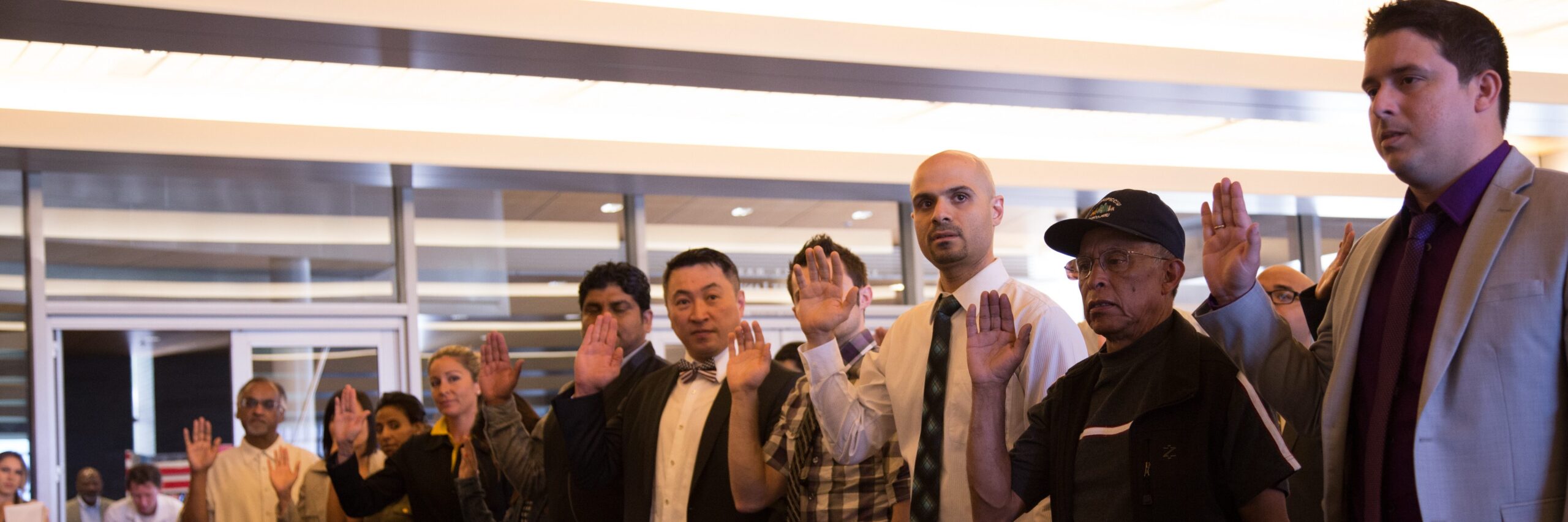
If you pass your interview, you can then participate in a naturalization ceremony. This could happen on the same day as your interview, if available. If a same-day naturalization ceremony is unavailable, USCIS will mail you a notification with the date, time, and location of your scheduled ceremony.

At the time you take the oath, you will turn in your green card and will receive your naturalization certificate. At some sites, there may be someone there to help you register to vote. Once you have your certificate of naturalization, you can register to vote and apply for a US Passport.

In addition, if you have any children under 18 who have green cards and are living with you, they may automatically become U.S. citizens. Consult with an immigration attorney or DOJ representative before proceeding. If your children qualify, they could apply for a Certificate of Citizenship (N-600) and/or a U.S. passport with proof of your relationship and your naturalization certificate.

Becoming a citizen is the final step of the naturalization process. You do not officially become a U.S. citizen until you have completed your Oath of Allegiance at a naturalization ceremony. After taking the oath, you will receive your Certificate of Naturalization, which serves as proof of your U.S. citizenship.

Until that moment, even if you have passed your citizenship interview, you cannot claim to be a U.S. citizen, register to vote, or vote. Doing so can jeopardize your immigration status and your ability to become a U.S. citizen.

Once you have taken the Oath of Allegiance, you become a U.S. citizen. One of the privileges of U.S. citizenship is the right to vote. Before voting, however, you must register to vote.

As a citizen, you can influence government decisions that matter to you, your family, and your community. Registering to vote is easy, and you can complete the voter registration form in your preferred language. In Washington State, you can register to vote online, by mail, or in person at a county elections office.